Gentle Opener
New features of our GO:
- 1600 mm wide
- only 5,5 kW suction needed
- 600 kg/ h
- roll-on/ roll-off for cylinders
- easy access to the opening sections
- h-type sealing of cylinder ends
- optional eliminating of hard pieces
- drives with frequency inverters
- Siemens PLC, SEW drives
MACHINES AND IDEAS FOR THE FIBRE PROCESSING INDUSTRY
Current hemp-processing machinery is largely based on technological principles that have remained unchanged for approximately a century. Conventional systems rely primarily on vibrational separation to detach woody shives from the fiber bundles. In addition, equipment originating from mid-20th-century cotton processing, such as step cleaners and trough-fed openers equipped with stripping knives, is still in use. Stripping knives are effective at removing three-dimensional seed kernels from cotton fibers by mechanical scraping. Hemp shives, however, have a predominantly two-dimensional, leaf-like morphology and therefore pass through such knife systems without being efficiently separated.
Fiber opening at mechanical clamping points (e.g., trough feeds or double-roller inlets) induces localized bending stresses. Because hemp fractures in a brittle manner similar to carbon fiber, such bending frequently causes fiber breakage and produces undesirable short-fiber fractions.
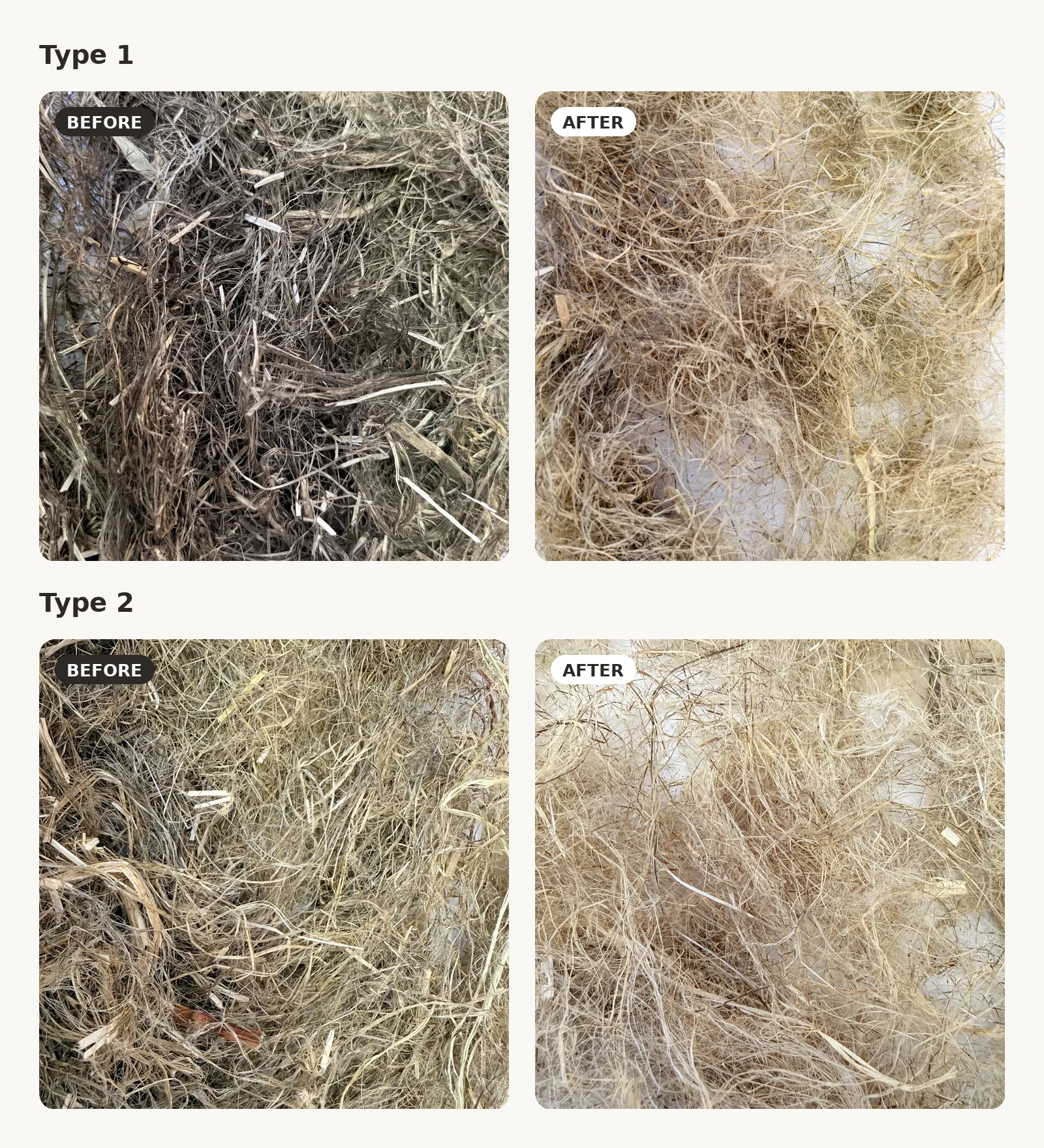
The HERGETH system addresses these limitations with a clamp-point-free opening mechanism that prevents fiber shortening. In this design, a lower wire-wound opening roller engages the hemp material and draws it toward a second wire-wound roller positioned above it, rotating in the same direction. The upper roller operates at a higher peripheral speed and rejects all particles larger than the point spacing of the roller clothing. This interaction produces a controlled "peeling" effect, similar to removing the outer layers of a carrot, which results in a consistent and reproducible degree of opening. Material rejected by the upper roller is returned via a chute for repeated processing until the fibers are fully liberated. Because the process avoids mechanical bending points, fiber integrity is preserved. During the return through the chute, small particles can be selectively removed through perforations. A feed roller upstream of the first opening roller allows adjustable separation of oversized fragments. The pre-opened fiber material can then undergo further opening and cleaning in an additional connected processing unit.